 21tv US
“While we hope for peace, our policy and objective must be to prepare our defence by all possible means according to our resources and capabilities.”
This historic remark by Thomas Jefferson, one of America’s founding fathers and its third president, remains highly relevant today. It continues to serve as a guiding principle for the national defence and security policies of independent, sovereign, and democratic nations in the modern world.
Bangladesh’s defence thinking is deeply rooted in the experience of our Liberation War. Victory in that unequal struggle against a much stronger invading force was not achieved by the Armed Forces alone. It was the total participation of the freedom-loving people of Bangladesh that turned a guerrilla resistance into a true people’s war and ultimately secured independence.
Alongside the heroic contributions of rebel officers and soldiers, the spontaneous support of ordinary citizens played a decisive role. People fought with weapons, provided intelligence, arranged food and shelter, and offered medical assistance. This broad public involvement transformed the Liberation War into what modern military terminology calls “people-centric warfare.” In Bangladesh’s case, this is not just theory — it is a historical reality written in blood.
Another cornerstone of Bangladesh’s defence philosophy is Bangladeshi nationalism. It nurtures a strong sense of national identity and responsibility among citizens. When people truly value their history, culture, heritage, and hard-earned independence, they develop a deep commitment to defending the nation’s sovereignty.
After independence, the late President Ziaur Rahman took the first major steps to institutionalize this idea. He understood that a small economy with limited resources could not rely solely on conventional military strength. He therefore introduced the concept of “Total People’s War,” emphasizing that national defence is not the sole responsibility of the Armed Forces but a collective duty of the entire nation.
His vision rested on three main pillars:
- Public awareness and active participation,
- A professional and capable Armed Forces,
- Development of a self-reliant defence industry.
As part of this initiative, he restructured the Bangladesh National Cadet Corps on 23 March 1979 by merging the University Officers Training Corps, Bangladesh Cadet Corps, and Junior Cadet Corps. At the same time, programmes were launched through Ansar-VDP and the Scout movement to instil discipline, leadership, patriotism, and basic military knowledge among the youth.
Unfortunately, after Ziaur Rahman’s assassination, many of these forward-looking defence initiatives lost momentum.
Today, the relevance of a “Total People’s War” approach has grown even stronger. Geopolitical rivalries, economic sanctions, and technological dependence pose serious challenges to smaller and medium-sized nations. In an era of intensifying strategic competition in South Asia and the Indo-Pacific, relying heavily on imported military equipment carries significant risks, as international alliances can shift rapidly during crises.
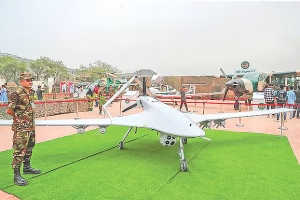
Many countries have recognised this reality and have reoriented their defence strategies accordingly. Over the past two decades, Turkey has made remarkable progress in drone technology, missile systems, and armoured vehicles, with 93 percent of the components for its famous Bayraktar TB2 drone produced domestically. South Korea fulfils around 70 percent of its defence needs through local production, while Israel has achieved high levels of self-reliance in military technology.
These examples show that building a domestic defence industry not only strengthens national security but also drives technological progress, industrial growth, and economic development.
A self-reliant defence industry means more than just manufacturing weapons. It encompasses the ability to produce ammunition, communication systems, surveillance technology, and other critical equipment. This reduces dependence on foreign suppliers and enables faster decision-making during emergencies.
Bangladesh possesses thousands of talented students in science, technology, and engineering, a fast-growing IT sector, and a large, energetic youth population. With the right policies and long-term planning, developing a strong domestic defence industry is entirely achievable. Such an industry would enhance military capability while advancing technological self-sufficiency and broader industrialization.
However, the ultimate strength of any defence system lies with its people. No matter how advanced the weapons or technology may be, they are operated by human beings. Therefore, the most vital element remains a professional, technologically skilled, strategically capable, and morally upright Armed Forces. In a democratic society, the military also serves as a symbol of national confidence and trust.
Bangladesh is highly vulnerable to natural disasters. The Armed Forces have repeatedly demonstrated their effectiveness in responding to cyclones, floods, and river erosion, proving that a strong military is essential not only for war but also for crisis management and national resilience.
Despite this, one major weakness in Bangladesh’s defence sector is the very low allocation for Research and Development (R&D). In the 2025-26 fiscal year, only 2.4 percent of the total defence budget is earmarked for R&D, while over 97 percent goes toward salaries and operating expenses. By comparison, India allocates around 22 percent and Pakistan at least 10 percent of their defence budgets to research and development.
Without significantly increasing investment in R&D, building a self-reliant defence industry will remain extremely difficult.
As George Washington, the first President of the United States and Commander-in-Chief of the Continental Army, famously said: “One of the most effective ways to maintain peace is to be prepared for war.”
Without a clear, well-defined National Defence Policy and Security Strategy, it will be challenging for Bangladesh to make adequate preparations to face future threats and challenges.
Writers: AKM Shamsul Islam (Retired Brigadier General), Defence Advisor to the Prime Minister Monir Haider, Special Assistant to the Chief Advisor of the Interim Government
The views expressed in this article are those of the writers.