 21tv US
Iran launched a fresh wave of missiles across the Middle East on Tuesday while explosions rocked its capital Tehran, following a strong warning from US President Donald Trump that America would destroy Iran’s power plants, oil wells, Kharg Island, and possibly desalination facilities if Tehran does not agree to end the war and reopen the Strait of Hormuz.
Israeli Prime Minister Benjamin Netanyahu, a key partner in the campaign against Iran, said more than half of Israel’s military objectives had been achieved. However, both Netanyahu and Trump declined to give any timeline for the operation, which has now triggered a month-long regional conflict and caused major turbulence in global markets.
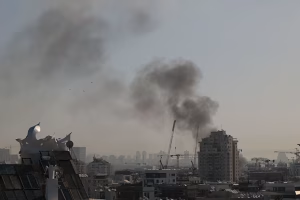
As air raid sirens sounded in Jerusalem, the Israeli military said it had intercepted new Iranian missiles. Iranian media reported fresh explosions in Tehran that caused power outages in several parts of the city.
Israel also confirmed that four more of its soldiers were killed in fighting in southern Lebanon, where the conflict has spilled over and Israeli forces are clashing with Iran-backed Hezbollah militants.
Before the latest strikes on Tehran, Israel issued a public warning on X (formerly Twitter) to residents in western Tehran, stating it would target military infrastructure in the area.
In response, Iran fired missiles at several Gulf countries it accuses of allowing US strikes from their territory. In Dubai, four people were injured by falling debris from intercepted missiles, while an Iranian attack sparked a fire on a Kuwaiti oil tanker at the port. Authorities in the UAE financial hub said the fire was later brought under control.
Saudi Arabia reported intercepting eight ballistic missiles fired from Iran. This came hours after Iran’s top diplomat urged Riyadh to expel US forces from the region.
President Trump warned on Monday that failure to reach a war-ending deal — which includes reopening the critical Strait of Hormuz — would result in the destruction of Iran’s electric generating plants, oil wells, and Kharg Island.
However, The Wall Street Journal reported that Trump had privately told aides he is prepared to end the military campaign even if the strait remains largely closed, a move that could leave Tehran with significant leverage over the waterway.
Defying the warnings, an Iranian parliamentary committee voted to impose tolls on all vessels passing through the Strait of Hormuz and to ban ships from the United States and Israel entirely. The strait normally carries about one-fifth of the world’s oil supply.
US Secretary of State Marco Rubio criticized the toll plan, telling Al Jazeera that it would set a dangerous precedent by allowing any nation to claim control over international waterways. He referred to the strait as what President Trump recently called the “Strait of Trump.”
Netanyahu told the US broadcaster Newsmax that the war is “definitely beyond the halfway point,” but added that he did not want to set a specific schedule.
The prolonged conflict and rising oil prices have become increasingly unpopular in the United States. Rubio said Monday that the war would likely continue for “weeks,” not months.
Egyptian President Abdel Fattah al-Sisi appealed directly to Trump, saying, “Please, help us to stop the war; you are capable of it.”
Pakistani Foreign Minister Ishaq Dar, whose country is acting as an intermediary, is scheduled to hold talks in Beijing on Tuesday with Chinese Foreign Minister Wang Yi on global issues, including the Iran crisis. Dar had hosted foreign ministers from Saudi Arabia, Egypt, and Turkey in Islamabad on Sunday and offered to host direct talks between the US and Iran.
Iranian Foreign Ministry spokesman Esmaeil Baqaei again denied any direct negotiations with Washington, saying the US had only sent a request for talks through intermediaries, including Pakistan.
Despite weeks of strikes and tight security, daily life in Tehran continues in pockets. A 27-year-old dental assistant named Fatemeh told reporters: “When I sit at a café table for even a few minutes, I can almost believe the world hasn’t ended. Then I go home to the reality of living through war, with all its darkness and weight.”
In Lebanon, Israel has intensified strikes on Hezbollah positions, including central Beirut. The UN mission in Lebanon reported that two Indonesian peacekeepers were killed when their vehicle was destroyed by an explosion of unknown origin, with two others wounded. Another Indonesian peacekeeper was killed on Sunday.
The Israeli military said it had launched an investigation to determine responsibility. France called for an urgent UN Security Council meeting, which was scheduled for Tuesday afternoon.
Meanwhile, finance ministers and central bankers from the G7 countries met in Paris to discuss the economic fallout of the war. Several nations have already begun introducing energy-saving measures.
Market analysts warned that a US ground operation or major Iranian retaliation could push oil prices to levels not seen since the 2008 global commodity boom.
Adding to the tension, Yemen’s Iran-backed Houthi rebels fired missiles and drones at Israel over the weekend, further threatening shipping in the Red Sea and the Gulf.